Showing posts with label game theory. Show all posts

Sunday, June 28, 2015

The Pirate Game

A few months ago, my friend was telling me about this mobile game he wanted to make. He, and some of our other friends, are teachers, and this is a game they play with their students. The students apparently love it. And if there were an app version, they'd be willing to pay 59p for it. Or so they say.

Now, as he was explaining the game to me, I thought maybe he was building towards asking for my help. I felt almost betrayed that he didn't. Several years ago, I'd built a website for this friend that he'd had nothing but praise and gratitude for.

A month or so later, I got a text message - "How are you at programming?" For whatever reason, the guy they had originally 'hired' wasn't doing it anymore.

"I'm capable", I replied. I'd done a course in Java at university. Admittedly, that was 'Java for Mathematicians'. And it was also almost 8 years ago. But how hard could it be to pick up again? Just like coding a bicycle. Or something like that...


The Game

As the title of the blog suggests, its called 'The Pirate Game'. In the classroom it's played on paper.

Basically, you have a 7x7 grid filled with items - mostly coins, but also some items that let you do other things. There are attacks that let you, for example, rob or kill other players. There's a shield and a mirror that let you defend against attacks. There's a bank item that let's you save whatever points you have from being stolen, etc. There's a bomb that blows you up (sets your points to zero). And so on.
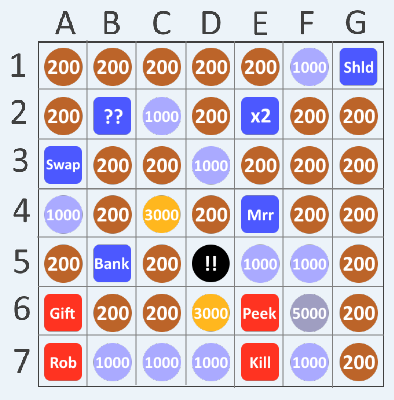
This is the prototyping design. The final product will look less utilitarian.

At the start of the game, the players arrange the items in their grids to their liking. The teacher (game) then calls out random squares, and the players get whatever is in that square on their own grid. In the classroom, if a player gets an attack item, they have to raise their hand and tell the teacher who they want to use it on. The winner is whoever has the most points when all the squares have been called.


Making Games 1: The Right Tools

In a previous blog, I asserted that making mobile games was difficult. In fact, it turns out to not be so bad with the right framework. In this case I used the popular LibGdx. What's particularly nice about it is that there are a lot of how-to guides, and there's plenty of help for when things go wrong.

As they say, programming is 1% inspiration, 99% Googling.

For anyone interested in making their own Android game, I found these guides particularly helpful,

LibGdx Zombie Bird Tutorial
LibGdx Game Development Essentials
Set up Google Services with LibGdx


HAL9000

I got a first working version of the game done in the space of about a month - this was just the basic game mechanics, a bare-bones interface, and a single computer opponent that I could play against to check that the mechanics were doing what they were supposed to.

In those first few tests of the game, I found that the computer player kept beating me - at one point, 7 to 1. This seemed strange - neither I nor the computer could choose who we attacked, or which defences we used. So really, there wasn't anything either of us could do to influence the outcome of the game. The winner should have been totally random.

So loosing 7 times out of 8 seemed significant to me. As far as I could tell, the mechanics were working correctly. The only theory I could come up with was that maybe there was some advantage in the order in which we took our turns.

To try and figure out what was going on, I created a simulation. Basically, I re-wrote a very stripped down version of the player and game mechanics in Python. I then had two computer players play against each other in 10,000 matches. The results from this were - Player 1: 5005, Player 2: 4995.
In other words, the winner was just random chance. And turn order didn't matter.

If nothing else, this was a lesson in not drawing conclusions from such a small data set - it's not really statistically significant if there are only 8 data points (that's a standard error of ~3). After playing more games, the wins did end up averaging out.


Making Games 2: Coordinating Players

Development progressed. I got the full game mechanics working, and added more computer players (Clu and Ultron). I was now able to choose who I wanted to attack and what defences I wanted to use.

But the ultimate goal for the game is to let users play against their (human) friends. This meant I had to do a massive re-write to generalise the interaction mechanics.

Okay, lets look at an example of an interaction. Say I want to swap points with another player. First, my device needs to pop-up a player select dialog. Once I pick a target, the game needs to inform that player that I'm trying to swap points with them. If that player has a shield, their device needs to pop-up a dialog asking if they want to use it. The game then needs to inform me of my target's response - and if the target doesn't defend them self, we need to tell each other what our respective points are so that we can complete the swap.

That's a lot of back and forth to handle. Here are the rough diagrams I drew when I was trying to get the mechanics straight in my head.

I doubt this helps clarifies things for anyone else.

So the way the interaction works in the code is, the attacker sends their target a data object telling them who the attacker is, what attack they're trying to use, and what points they have (though the points aren't visible to the target). Once the target has chosen their defence, they complete their side of the attack processing - so in the swap example, if the target doesn't defend, they set their points to those of the attacker.

The target then sends the attacker's original data, along with the defence they chose (if any) and their (pre-attack) points to all the other players. If the recipient is the original attacker, they complete their side of the attack. Then, all players are shown a notification telling them what happened.
I figured I should give the computer players more piratical names.

All this coordination is done by a turn handler class. And what's nice is the computer players can also interact with each other, and with the local human player, via the turn handler.

All I need to do now is set up the stuff that actually sends the data between network players.


Game Theory

Through testing (looking for bugs and the like), I've played this game A LOT. And I've gotten a pretty good feel for how it works. It's actually quite fascinating when you really get into it. (Or maybe that's just Stockholm Syndrome talking).

Information is important to the game. Without it, players would be forced to make their moves at random. And when that happens, winning becomes mostly random chance. This is why players are shown notifications when other players interact - it allows them to strategise.

The most basic strategies are things like - rob people who have lots of points, don't try to rob people who have just been killed (they don't have any points to take), defend yourself when you have a lot of points (if you can). Really, this is just being sensible.

Then there are more subtle strategies. For example, sometimes it's better to lose a lot of points to the bomb or to being killed (removing those points from the game) rather than letting another player take them. Because, you don't need a lot of points to win, you just need more than everyone else.

Given the inherent randomness of the game, a lot of how you play will come down to how risk-averse you are. For example, a particularly risky strategy might be to let an opponent rob you (saving your defences), in the hopes that you can steal back your points, and more, later on.

When you play against humans (rather than AI), a whole bunch of social factors can come into play too. From what I hear, in the classroom, students tend to disproportionately target any members of staff that are playing. Though I can't imagine why.

One other interesting feature of the game is that it sometimes forces players to make disadvantageous moves. There's the bomb item that will take away your points when it inevitably comes up. And if you're in first place, the swap item forces you to give your points, and the lead, to another player.

So yeah, the game's not as simple as it might seem on the face of it.


Artificial Intelligence

In the first fully featured version of the game, the computer players made their decisions completely randomly. And that was fine - the game is perfectly playable with random opponents, it's not too easy, and the randoms can and will beat you on occasion. Sometimes by an embarrassing margin.

But random players also do things that don't make sense. So I wanted to create some computer players that used basic strategies to play more intelligently.

For interactions, these intelligent computer players (AI) use literal hit lists and avoid lists. As mentioned above, when two players interact, that information is sent to all other players. For humans, this information is displayed as a notification. For the AI, the information is processed to build/modify the hit and avoid lists.

For example, if Player 1 steals a lot of points from Player 2, then Player 1 is added to the hit list and Player 2 is added to the avoid list. If another player then kills Player 1, Player 1 is removed from the hit list and added to the avoid list. And so on.

If the AI then gets an attack square, they'll first check their hit list for a target. If the hit list is empty, they'll chose a random opponent who isn't on the avoid list. And so on.

There are also various basic heuristics for choosing which defences to use (and when), and for choosing a square when they get 'Choose Next'.

As they are, the AI are quite formidable, and at times frustratingly so. In general, I think it's better to have a mix of random and intelligent computer players. The AI offer a challenge, while the chaotic influence of the random players keeps things interesting.


Measuring Difficulty

In the game's current form, you can play against 2-7 computer players, and these players can be either random or 'intelligent' (as above).  That means 33 unique opponent set-ups. Which raises the question - how can we rate the difficulty of any given set-up. 

Obviously it's harder to win when there are more opponents. Specifically, the probability of a random player winning in a game of N random players is 1/N. Think of it like this - if all the players behave in the same way, they are indistinguishable. And if they're indistinguishable, they must all have the same probability of winning (turn order doesn't matter).

The same logic applies to intelligent computer players (AI) - since they all follow the same set of rules, they must also be indistinguishable from each other. Therefore, the odds of an AI winning in a game of N AI players must also be 1/N .

But what happens when there's a mix? How much harder are AI to beat than randoms?

To answer that, we can run some more simulations. This time, instead of re-writing code in Python, I created a modified version of the turn handler (see above) within the game project itself. Essentially I just removed all code that related to human players, and added a few bits to track statistics.

I set up the 33 different player configurations, ran 10,000 matches for each, and worked out the probability of winning for an AI player - for simplicity, we're assuming that a human player (playing strategically) is roughly equivalent to an AI.

From those simulations I made this lovely surface plot (using matplotlib).

Configurations with more than 7 opponents have been set to zero.

And what we find is AI are roughly twice as hard to beat as randoms - notice the surface is higher on the right hand side (when there are fewer AI).

In other words, your odds of winning in a match against two AI is roughly equal to your odds of winning in a match against four randoms. For simplicity, we're going to assume that the relationship is exactly two to one.

We can now calculate an approximation of the odds of winning as

\[ p(R, I) = \frac{2}{R + 2(I+1)} \]

And if we compare these probabilities to those from the simulations, we find that they are within standard error (order 0.01 for 10,000 trials).


To get a difficulty rating, we can just turn the probability on it's head, and normalise by the probability for the easiest set-up (2 random opponents). That is,

\[ D = \frac{p_0}{p} = \frac{R + 2(I+1)}{4} \]

This gives us a difficulty rating between 1 and 4, which lets us easily divide the difficulty into three levels - easy, medium, and hard. Though, if your odds of winning in the easiest possible game is only 50:50, can it really be considered 'easy'?

Another nice property of this difficulty rating system is that the difficulty ratios match the probability ratios - that is, your odds of winning a 2 are half your odds of winning a 1, and so on. Specifically, your odds of winning are roughly \( \frac{1}{2D} \)

Incidentally, if we assume our human player instead makes their moves completely at random, then their odds of winning are lower overall - \( p = \frac{1}{R+1+2I} \) - but the difficulty stratification works out the same.


Conclusion

Ordinarily, I'd include my code for this sort of thing. But in this case, doing so might undermine my (and my friends') income. And they very kindly told me that I'd get the majority of the profits. Whatever those may ultimately be.

So far we've made a whopping 7p (!) just from having adMob set up in the test builds.

But before we can make any (real) money, we have to actually finish the game. The single player version is mostly done, and should be released in the near future. The last big thing to do is the UI (which is someone else's problem job).

Then the hard part is going to be setting up multi-player with Google Play Services. In particular, because there aren't any good guides (that I can find) for setting up Google multi-player with LibGdx.

When it is done, I'll post links and such here for anyone that might be interested.

[edit] - If you want to try the current beta, you can get it here.

Also, given that making an Android game has turned out to be much easier than I expected, I may in fact make the previously discussed relativity game myself (once the Pirate Game is finished). In that case, I might also provide my code.


Oatzy.


[I'd love to make an AI that uses machine learning to counter human players' personal strategies.]

Saturday, September 29, 2012

Picking a Seat on the Tram

When I'm at university, I have to get the tram twice a day. Now I quite like the trams in Sheffield (at least, more than the trains and buses). But if there's anything I can do to get a little more leg room or personal space, then I'm going to try it.

On the way in to university, I get on the tram at the start of the line - i.e. the tram is more or less empty when I get on, so I have pretty much free choice of where I sit. In the main, middle section of the tram, seats are grouped into fours - two forwards, two backwards, face to face - and there are there are 5 rows and 2 columns of these groups.

(The are more seats in the front and rear carriages, but with difference layouts. And I almost never sit in those sections, so I'm ignoring them.)

When the tram's busy, you have to accept that you're probably going to be squashed, and bumping knees with the person across from you, and desperately trying to avoid awkward eye-contact. But when it's less busy, there's the chance for a bit of personal space.

The question is, where's the best place to sit (assuming you have free choice) so you're more likely to get some of that personal space?

Truth be told, I don't actually know. I figured, probably the best place is the forward-facing window seat in either of the 3rd (middle) row groups.

The logic was that a person would either have to sit next to you, or so they're facing backwards - generally less preferable options. And since people are more likely to grab seats nearest doors, the 3rd row is 'best' because it's equidistant from both doors.

Of course, if the front and rear doors aren't used equally, then the choice of row would have to be tweaked.


From that, I started thinking about how people chose which seat to take in a given four-group. And since I have nothing better to do than stare out the window for the 20-odd minute journeys, I figured I'd try to model it.

From empty to full there are 16 possible seat use configurations ('states'). People chose seats based on personal preferences, as well as which seats are already taken. So, for the model, we look at the different states, and consider how they might change with the addition or removal of various numbers of people.

Here's an example, that I sketched, of possible transitions resulting from the addition of one person at a time
The red lines are possible changes of state where the number of people stays the same (usually after the removal of others). More on that later.


Now, the key thing here is that different states, and different transitions are more likely to occur than others.

For eample, a person with free choice is more likely to chose a forward-facing seat (some people tend to feel unwell traveling backwards), and a window-side seat so they've got something to stare at; unless they're planning on making a hasty exit.

So that would theoretically make the backward-facing aisle seat the least popular.

HOWEVER, if someone's already sat in FFWS, then BFAS becomes the more preferable, since it avoids having to sit next to, or directly in front of, some random stranger whose just staring blankly out the window in an unsettling sort of way. Also, personal space.
And from there, if you introduce another person, they're most likely to sit FFAS, since BFWS is a bit awkward to get to and leaves you feeling kind of boxed-in. Plus you have the extra arm room on the aisle-side, and, if necessary, you can turn slightly to give yourself a little more leg room.

And if you add a four person, they have a hell of a time getting to the free seat, but it's their only option. Unless BFAS moves across to the window.

Now, back to those red lines in the diagram. From the 3-config described above, say BFAS leaves. You now have two people sat next to each other. The person in FFAS may then chose to move to BFAS for the sake of more personal space. This is kind of like how physical systems tend towards their lowest energy (least socially awkward) state.


The model itself is actually pretty straight-forward. What you do is construct a stochastic matrix (sometimes called a transition matrix) - basically, a 16x16 'table' that tells you the probability of the seating changing from one state to another. For example
And this works for all possible transitions between all possible states.

The tricky part if determining the probabilities. You could just make random guesses at it. Or, if you were really determined, you could spend a load of time on trams, recording what transitions happen at each stop and how many times they happen. I don't plan on doing either.

But say you have your data and you've constructed your matrix, M. You could do a Monte Carlo type simulation using those probabilities. But with a stochastic matrix you can be more precise.

See, if you calculate M*M, then the entries are the probabilities of moving from state i to j after two 'stops'. And if you calculate M^n, they you get the transition probabilities for after N stops.

And if you add up the entries down each column, j, then you have the probability of being in state j after N stops - that is, you can find the most likely seating configuration after some arbitrary number of stops. You could also use this method to work out the popularity of each seat over all possible states.

Which I think is pretty cool.


And that's all well and good for the groups. But what if you want to model the whole tram? That's where things get tricky, since you have to model how people chose seat groups, which itself depends on what seats are already taken in groups.

Ultimately, it can be modeled the same way, with a transition matrix. Only now, you're working with a 40x40 matrix.

Not difficult, per se, but certainly requires a lot of data and number crunching...

Come to think of it, if you were going to go to the trouble of observing and counting state transitions, you could just count how many times each seat is sat in over some arbitrarily long period to figure out each seat's popularity. Then you just need to try to get the seat next to the least popular.

But counting isn't as fun as modeling.


Oatzy.


[I wonder what normal people think about on public transport..]

Wednesday, August 03, 2011

The Toilet Seat Conundrum

Gentlemen, do you leave to toilet seat up, or courteously put it down after use?

I read a (somewhat tongue-in-cheek) article a while back, I can't remember where, that explained the toilet seat conundrum in terms of game theory.  As best I can remember, it was quite clever. I was recently reminded of it when reading a Cracked article, and thought I'd try to recreate it, and - as is my wont - take it a step further.

Game theory, for those unfamiliar, is an area of maths/economics that studies 'competitive' interactions, "in which an individual's success in making choices depends on the choices of others".


Preamble

The (average) probability of the gentleman needing to 'sit down' when visiting the bathroom, we call p*. The probability of not is (1-p).

If the toilet seat is in the 'wrong position' for a given visit, we call the cost of this c1, and we assume that this cost is the same for both genders. This may not be strictly true.

The simplest cost would be in having to move the seat, typically in the form of mild inconvenience, and the potentially unpleasant experience of having to touch the underside of the seat. I'm also told that there are certain perils in visiting the toilet at the night, if the seat is in the upright position and is required to be otherwise. I can't say this is a cost I've ever experienced.

One might argue that the 'costs' are inconsequential; but for the sake of arguing, they aren't.

For the sheer hell of it, we'll call the woman Alice and the man Bob. Alice and Bob have been in a relationship/living together just long enough to quarrel over such matters. I suspect, for most people, this is a non-issue; but that's not the point of the post.

There is a third possible game, not discussed below, in which Bob can just leave the seat down at all times. In this case, we have c3, the cost of clean up if Bob's aim isn't quite up to scratch.

Oh, and there is a fourth game, where the default position of the the seat is upright. This is the worst possible game for Alice, and is only the best possible game for Bob if p<0.28. I can only imagine this game working in an all male household, and even then (a re-adjusted) Game One works out better.


Game One - Leave It As Is

Probability of the seat being down is the probability of Alice being the last to visit the lav plus the probability Bob was the last and left the seat down. Probability the seat is up is 1 minus the above.

Here's the cost matrix for this game
Where cost is c1 multiplied by the probability that the seat is in the wrong position

To get the total costs to Alice and Bob for this game, we work out

(Probability the seat is down x the cost if seat is down) + 
(probability seat is up x cost if seat is up)
And we can work out the ratio of costs
B:A  =>  2p+1 : 1

In the extreme case, where p=0 (Bob never poops), their costs are equal. But in all other cases, Bob's cost is greater than Alice's.


Game Two - Return to Default

Default meaning the seat is always returned to the downright position after use. The probability of the seat being up is always 0.

Here's what the matrix looks like
In this case, Alice incurs no cost. Bob, on the other hand, incurs double cost - when he needs to urinate, he has to move the toilet seat twice: up before use, and down afterwards.

It's obvious that Alice, once again, fairs better than Bob.

Game Three, mentioned in the preamble, works the same as this, but with 2c1 replaced with c3. Alice still comes out better though. Unless she doesn't like the thought of sitting on a toilet seat that's (potentially) been peed on - even if it is cleaned - in which case, there's some abstract cost to her.

If she doesn't mind, then which of games Two and Three Bob would prefer depends on which is smaller: 2c1 or c3.


Lowest Costs

First of all, we note that in both games Alice comes out better than Bob - incurring a lower cost in both cases. That said, Alice does better in the latter game, incurring no cost at all in that one. So Game Two is preferable to Alice.

But what about Bob?

If we take the cost ratio of game one to game two for Bob, this is what we get
B1:B2  =>  2p+1 : 4

In the extreme case of p=1 (Bob never urinates), Game Two incurs a greater cost for Bob (3:4) - and by extension, Game Two always incurs a greater cost to Bob.

THIS is where and why the conflict arises.

Alice prefers Game Two, Bob prefers Game One.


Tipping the Scales

So Alice would prefer to play Game Two, but she has to encourage Bob towards it. So Alice introduces a new penalty - c2 - for Bob leaving the toilet seat up.

The cost will typically be something along the lines of a bollocking, silent treatment, arguments, or whatever.

So what we do is this - the odds of Bob leaving the toilet seat up, and Alice being the next to use the bathroom -> (1-p)/2

Multiplied by the cost, c2, and added to the pre-existing total cost for game one
Now, we - or rather, Alice - wants the cost to be such that Game Two is preferable, i.e. B'1 > B2

Rearranging and simplifying, we get
c2 > 4c1(2p+1)

However, if Alice were feeling kind, she could introduce a 'reward' for putting the toilet seat down, instead. It works effectively the same - barring psychological, carrot/stick considerations.

For this, Alice would have to offer a reward, R, with
Arguably, Bob could introduce a new cost - or enticement - himself, to 'persuade' Alice towards Game One. But TV leads me to believe that this is seldom thought of, or executed.

This might be because Alice has more to gain/lose - in as much as, Alice can avoid any cost by 'playing' Game Two. Bob, on the other hand, incurs some cost in both games.

You can draw your own conclusions on that one.

In terms of a co-operative solution, if we add together Alice and Bob' costs in each game and compare, we find that Game One has a lower total cost than Game Two.

So one could argue that Game One is better overall. The challenge, though, is convincing Alice that that is the best solution for both of them, given that, from Alice' point of view, she does worse in Game One.


Casino Bathrooms

So this is all well and good, but it's kind of a specialised case - the situation of a house with one male, one female, and one toilet. In our house, for example, we have two males, two females and three toilets. What then?

There are a few other problems with the probability-based approach, as well. For one thing, it uses an average poop-probability for the gentleman. It also assumes both Alice and Bob use the bathroom about the same number of time during a given time period - whereas some people have more robust insides than others.

So for this, we create a Monte Carlo simulation.

[This is what we call excessive commitment to an idea.]

In the simulation, we create a 'person' object, and assign to them a gender, an average number of bathroom visits, and, for males, an average bladder to bowel movement ratio. To capture the day to day variability in number of visits to the bathroom, we use Poisson distributions.

We also create a 'toilets' set, representing however many toilets there are, and their current states -> 1 = toilet seat up, 0 = toilet seat down. Each toilet has an equal chance of being chosen for use by any given person at any given time.

Each person has a counter, which is incremented when the person in question has to move the seat. At the end, these counters are grouped by gender for comparison.


In the Middle of Our Street

So I created a 'house' of two males, two females, and three toilets (variables chosen arbitrarily). Then ran the simulation for 10,000 hypothetical days.

The Game One simulation gives a result of ~ 3.28 seat moves per male per day, and 2.27 seat moves per female per day. That's a male:female seat move ratio of 1.44.

The Game Two simulation gives a result of 9.11 seat moves per male per day - bearing in mind, men have to move the seat twice per standing visit, in this version - and women never have to move the seat.

Code here.

Fun fact: Without additional costs and rewards, Game One is always preferable to men, Game Two to women. Regardless of the balance of men and women in a house.

So now you know!


Of course, in some cultures the conflict never really arises, since it is 'the norm' for men to sit for all visits to the lavatory.


Oatzy.


*[inb4 shouldn't p be the probability of needing to urinate lol]